
Case Study: How The Frank Co. Helped a Global Fashion Brand Turn Living Wage Data into Better Buying Decisions
This brand has requested to remain anonymous due to commercial confidentiality. This case study is based on a real engagement and reflects genuine data, challenges, and outcomes.
Using real payroll data to uncover hidden supply chain risks, strengthen worker welfare, and equip sourcing teams with the insights they need to make more responsible purchasing decisions.
Most fashion brands believe they have a clear understanding of what is happening across their supply chains. They commission ethical audits, collect supplier questionnaires, monitor compliance scores, and publish annual sustainability reports. While these activities provide valuable oversight, they often leave one critical question unanswered: Are workers actually better off than they were last year?
For one global fashion brand, the answer proved far more complex than expected.
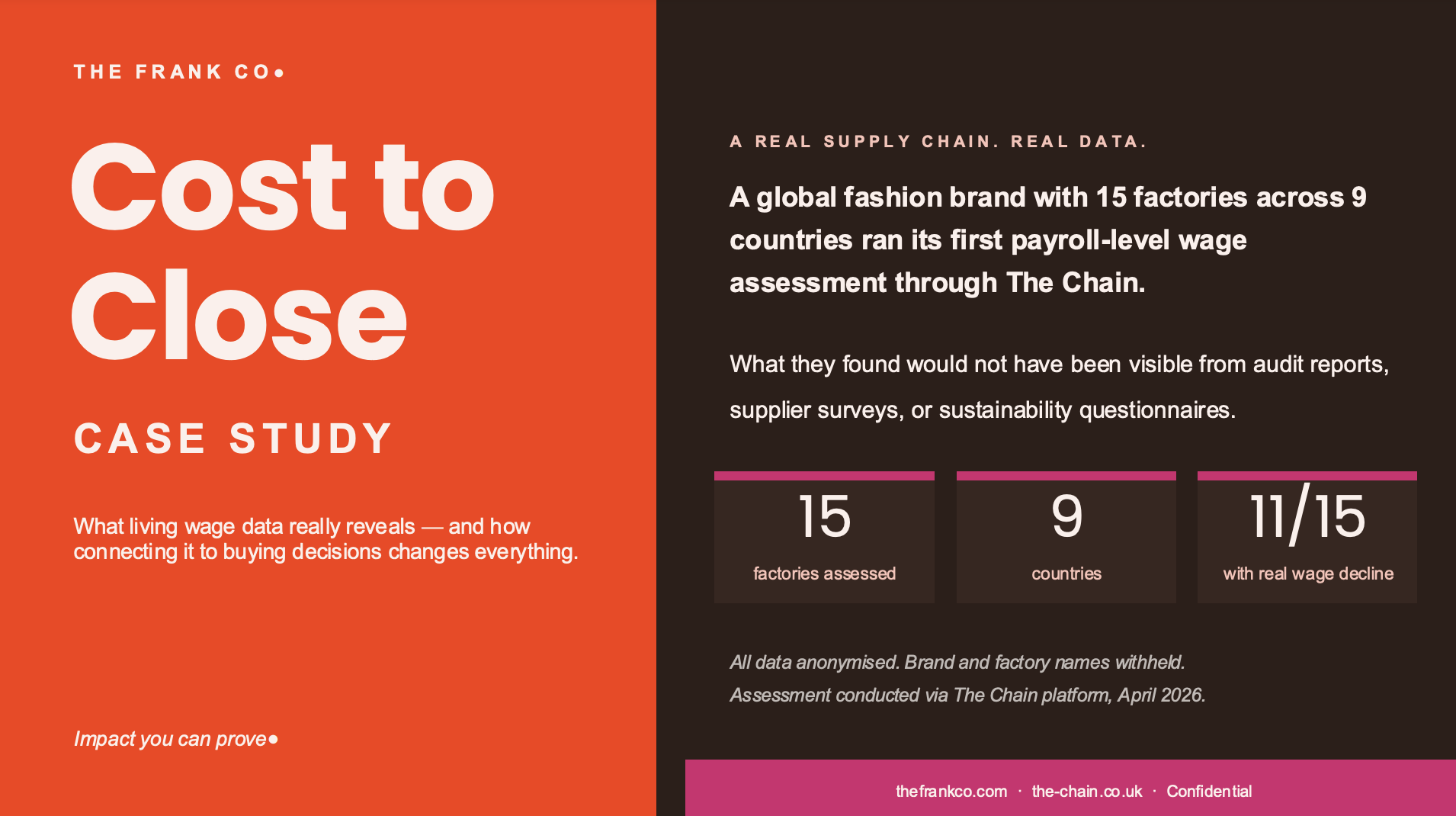
Working alongside The Frank Co. and using The Chain platform, the brand conducted its first payroll-level living wage assessment across 15 factories in nine countries. Instead of relying solely on audit reports or supplier declarations, the assessment examined real payroll records to measure wages, purchasing power, inflation, and living wage compliance at factory level. The findings fundamentally changed how the company approached responsible sourcing and demonstrated why traditional compliance reporting alone can no longer provide the complete picture.
The Challenge
Like many international fashion brands, the client had invested significantly in responsible sourcing programmes over several years. Supplier audits had been completed across the network, sustainability reporting processes were well established, and compliance performance appeared strong throughout much of the supply chain.
However, the leadership team recognised an important limitation. Although audits provide valuable information, they offer only a snapshot of conditions at a specific point in time. They rarely reveal whether workers are becoming financially better off, whether inflation has eroded wage increases, or how purchasing decisions made by brands directly affect worker livelihoods over time.
As a result, the business wanted evidence rather than assumptions. It needed a way to understand what was really happening inside its factories and whether existing compliance programmes accurately reflected workers' day-to-day realities.
To answer those questions, The Frank Co. designed a comprehensive wage assessment using The Chain platform, analysing payroll data from 15 factories operating across nine countries.
Looking Beyond Traditional Compliance
Rather than asking whether factories complied with existing policies, our assessment examined the data that matters most: payroll records, inflation-adjusted wages, living wage benchmarks, workforce demographics, and purchasing information.
This approach provided a far more accurate picture of worker wellbeing than traditional compliance reports alone.
The analysis revealed an uncomfortable but important truth. Although wages appeared to be increasing across several locations, workers in many factories had actually become poorer.
Across the supply chain, 11 of the 15 factories experienced negative real wage growth, meaning wage increases failed to keep pace with inflation. As a result, workers' purchasing power declined despite receiving nominal pay rises. Overall, 73% of the assessed factories recorded negative real wage growth, a finding that would have remained completely hidden without inflation-adjusted analysis.
This demonstrated why measuring wage increases in isolation can create a misleading impression of progress. Real worker welfare can only be understood when inflation and local economic conditions are considered alongside payroll data.
Measuring Living Wage Compliance Properly
Beyond analysing wage growth, The Frank Co. evaluated every factory against recognised living wage benchmarks.
Although the factories formed part of the same supply chain and supplied the same brand, the results varied dramatically.
Several European factories achieved 100% living wage compliance, while the lowest-performing facility achieved just 22% compliance. Overall, five factories were classified as low risk, five required closer monitoring, and five required immediate intervention because significant numbers of workers remained below recognised living wage thresholds.
These findings reinforced an important lesson.
Looking only at company-wide averages can conceal significant risks at individual factories. Effective ESG programmes require granular, factory-level intelligence that allows businesses to identify precisely where intervention is needed and where resources should be prioritised.
Revealing the Inflation Trap
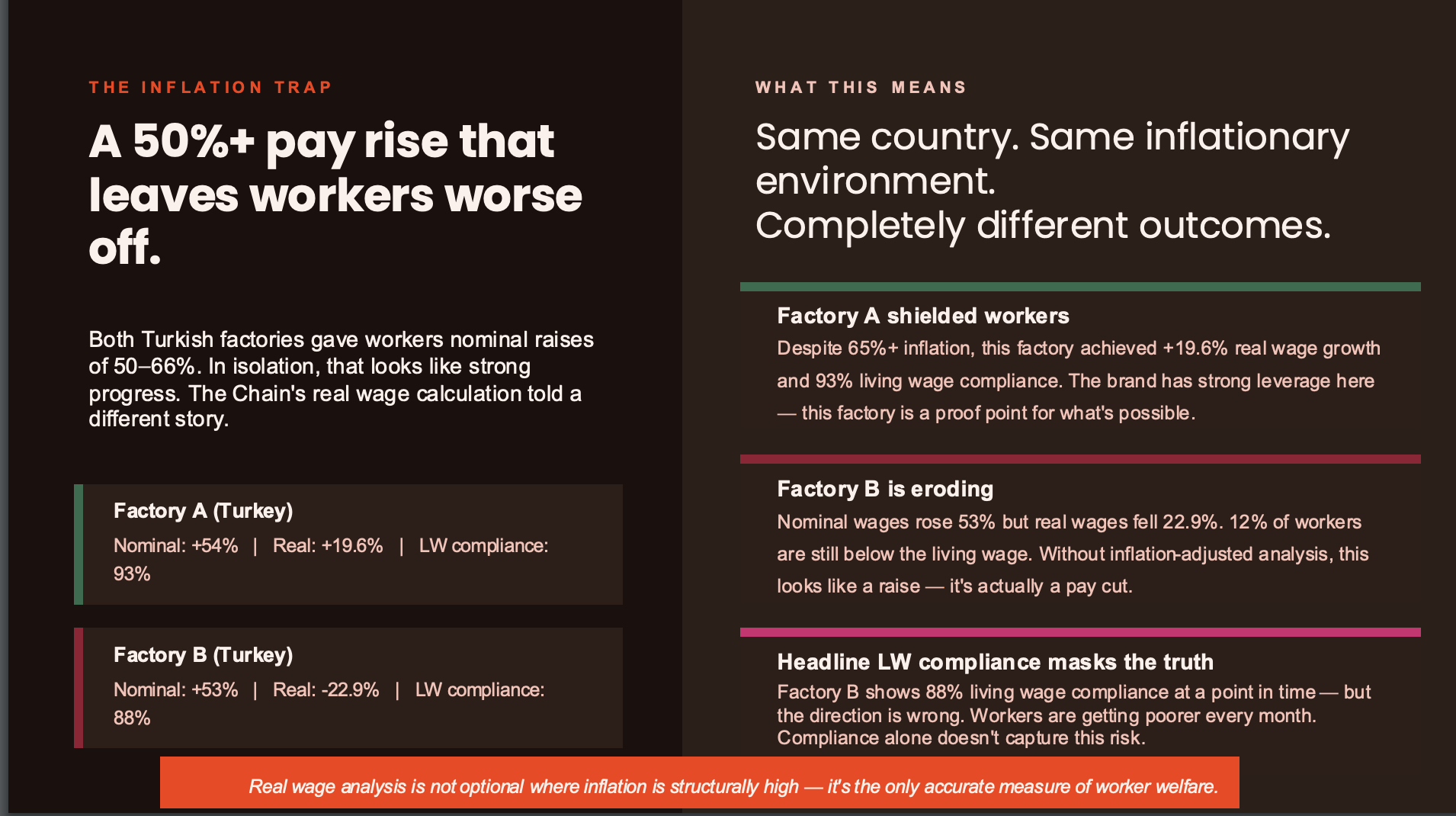
Perhaps the clearest example emerged from two factories operating within the same country.
Both factories had announced wage increases of more than 50%, which initially appeared to represent exceptional progress.
However, once inflation was incorporated into the analysis, the picture changed dramatically.
One factory successfully protected workers' purchasing power, achieving positive real wage growth while maintaining strong living wage compliance.
The second factory, despite announcing a similarly impressive pay increase, recorded a 22.9% decline in real wages because inflation had outpaced wage growth. Workers were earning more on paper but could afford significantly less in practice.
Without real wage analysis, both factories would have appeared equally successful.
Instead, The Chain clearly demonstrated that identical wage increases can produce completely different outcomes depending on inflation and local economic conditions. For sourcing teams, this distinction is critical because compliance percentages alone cannot identify factories where worker welfare is actively deteriorating.
Understanding the Real Gender Challenge
The assessment also explored gender pay data across participating factories.
Rather than uncovering widespread evidence of unequal pay for equal work, the analysis revealed a more structural challenge.
Women were heavily concentrated in lower-paid production roles, while men occupied a greater proportion of supervisory and administrative positions. Consequently, headline gender pay gaps were driven primarily by occupational segregation rather than unequal pay rates for identical jobs.
This insight fundamentally changed the client's response.
Instead of focusing solely on salary adjustments, leadership could begin addressing recruitment, career progression, skills development, and promotion opportunities for female employees. This type of workforce intelligence enables businesses to develop long-term solutions that improve equality rather than simply addressing surface-level metrics.
Introducing "Cost to Close"
One of the most valuable innovations developed during this project was Cost to Close.
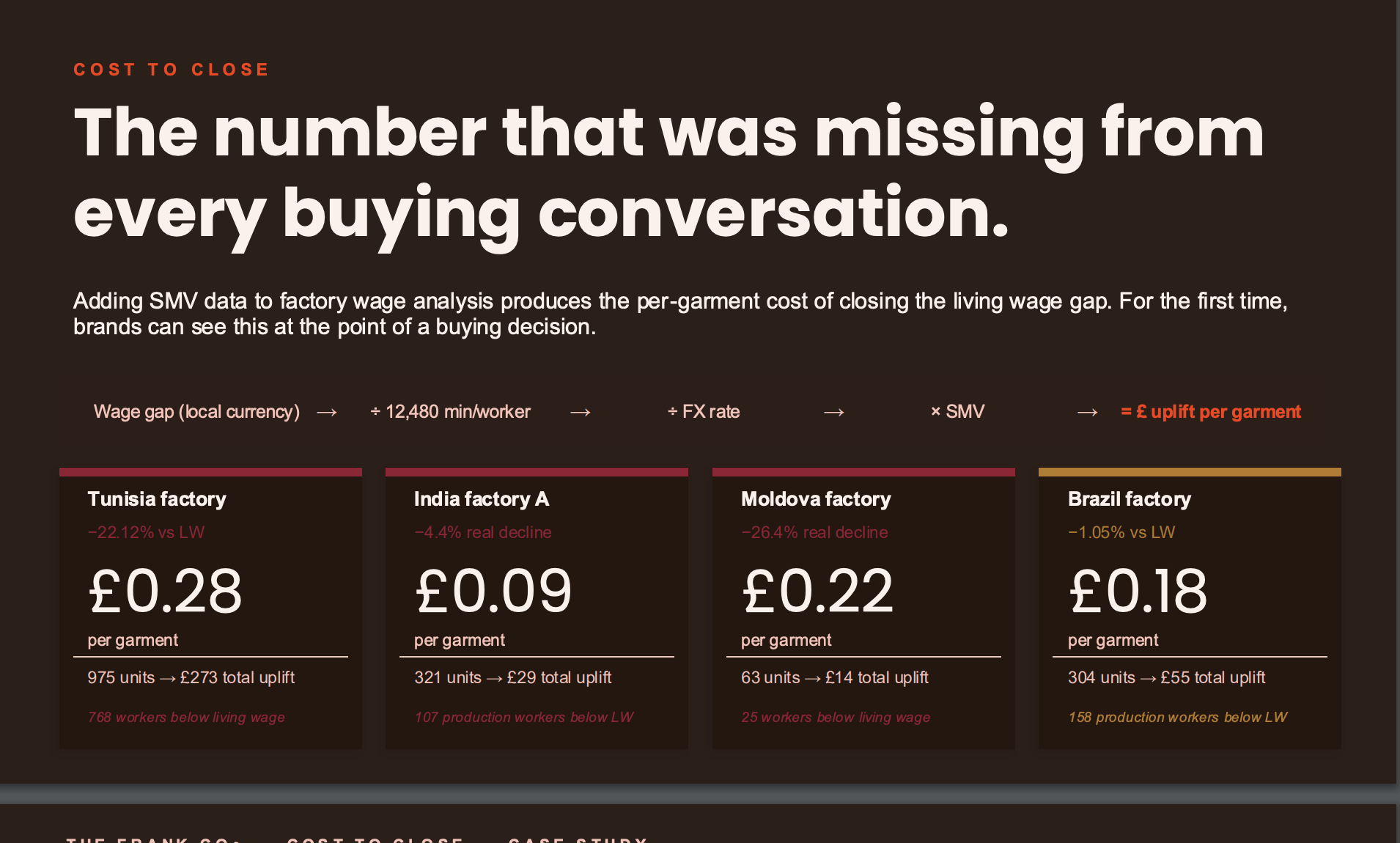
Historically, brands could identify whether factories met living wage benchmarks, but they had no practical way of calculating the financial investment required to close remaining wage gaps.
The Frank Co. solved this challenge by connecting payroll data with Standard Minute Values (SMVs), production information, and product costing.
As a result, buyers could see, for the first time, the precise cost required to achieve living wages before placing an order.
The findings demonstrated that meaningful improvements were often far more affordable than expected.
In one factory, closing the living wage gap required an additional investment of just £0.09 per garment. Another required £0.18, while higher-risk factories required between £0.22 and £0.28 per garment.
Instead of debating whether improving wages was financially realistic, sourcing teams could make purchasing decisions using verified commercial data that quantified the investment required.
Prioritising Action Where It Matters Most
The assessment also identified three factories requiring immediate attention.
One North African facility recorded only 22% living wage compliance, while real wages had declined by almost 32%, leaving hundreds of production workers below recognised living wage levels.
A South Asian factory showed every production worker earning below the living wage benchmark across multiple reporting periods, confirming that the issue was structural rather than temporary.
Meanwhile, an Eastern European factory experienced one of the steepest declines in real wages across the entire supplier portfolio, with inflation significantly eroding purchasing power despite relatively stable nominal wages.
Because The Chain combines payroll records, wage benchmarks, inflation data, and production information within a single platform, the client was able to prioritise corrective action based on measurable evidence rather than relying solely on audit findings.
The Results
The engagement fundamentally transformed how the client approaches responsible sourcing.
Rather than treating worker welfare as a compliance exercise, the business now uses payroll intelligence to inform commercial decision-making across its supply chain. Wage gaps can be quantified, real wage trends are monitored over time, gender analysis identifies structural workforce challenges, and sourcing teams can understand the financial implications of improving worker welfare before purchase orders are placed.
This shift enables the organisation to move beyond reactive compliance towards proactive, evidence-based supply chain management.
Why This Matters
Many ESG programmes tell businesses whether they comply with existing standards. However, very few explain why problems exist, where they are occurring, how serious they are, or what investment is required to solve them.
That is where The Frank Co. delivers measurable value.
By combining ESG expertise with The Chain platform, we move beyond audits and reporting to provide practical, evidence-based intelligence that helps brands make better decisions across their entire supply chain. Our approach enables organisations to identify hidden risks, prioritise meaningful interventions, and connect sustainability directly with commercial decision-making.
As regulatory expectations continue to increase and stakeholders demand greater transparency, data alone is no longer enough. Fashion brands need actionable insight, measurable evidence, and the confidence that every sustainability decision is supported by robust analysis. That is precisely what The Frank Co. helps our clients achieve.